
Real Hamilton Solar Project
18 kW Residential Solar in Queenwood, Hamilton
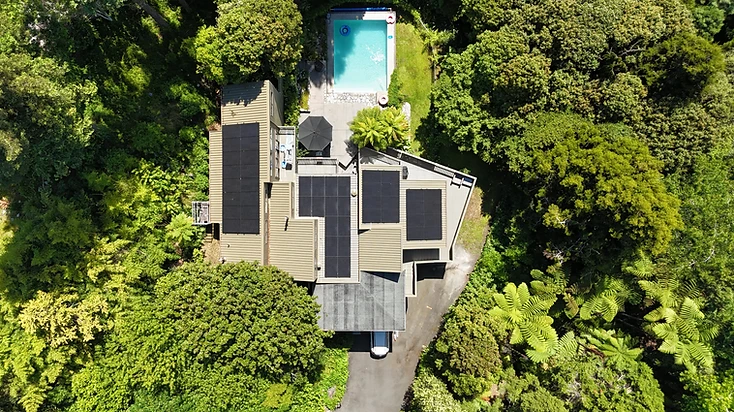
North, flat and south-facing solar on a heavily treed Hamilton property, with real generation data and actual electricity bills to show how the system performs.
18 kW
Total solar installed
10.8 MWh
Generated Jan to Sep 2026
3.08 MWh
Generated by the south-facing array
Not every home has a perfect north-facing roof with clear sun all day.
This Queenwood property sits amongst mature trees and has multiple roof levels and orientations. Rather than limiting the installation to one roof face, 2E Electrical designed the system around the usable roof space available across the property.
The result is an 18 kW residential solar system, with 10 kW across the north-facing and flat roof areas and a further 8 kW on the south-facing roof.
Because the two sections are monitored separately, we can see exactly how the south-facing solar performs compared with the north and flat-roof panels on the same Hamilton property.
Project at a Glance
- Location
- Queenwood, Hamilton
- Total Solar
- 18 kW
- North + Flat Roof
- 10 kW
- South-Facing Roof
- 8 kW
- Inverters
- 2 separate solar inverters
- Battery
- No battery
- Installed By
- 2E Electrical
Not a Textbook Solar Property
This property sits down amongst mature trees and has a complicated roof with several levels and orientations.
A simple approach would have been to use only the most favourable roof area and disregard the rest.
Instead, we looked at the usable roof space across the property and designed the installation as one overall system.
The north-facing and flat-roof sections were installed first on a dedicated inverter. The planned south-facing array was completed later on a second inverter.
This also gave us something particularly useful: separate monitoring for the two parts of the installation.
Can South-Facing Solar Work in Hamilton?
South-facing solar is often ruled out straight away.
North-facing panels generally have an advantage in New Zealand, particularly through winter. But roof orientation is only one part of designing a solar system.
This property had a substantial amount of usable south-facing roof space.
The question wasn't whether the south-facing panels would produce as much electricity as the north-facing panels. We knew they wouldn't.
The question was whether that roof could still produce enough useful electricity to make it worthwhile.
After nine complete months of monitoring both systems side by side, we have real data to answer that.
10.8 MWh Generated in Nine Months
From 1 January to 30 September 2026, the complete 18 kW system generated approximately:
7,713 kWh
10 kW
North + flat array
3,082 kWh
8 kW
South-facing array
29%
Of total generation came from the south-facing array
Combined generation: 10,795 kWh
That's more than 3,000 kWh of electricity generated from south-facing roof space that could easily have been disregarded.
Figures are actual system monitoring data from 1 January to 30 September 2026.
North vs South Through the Seasons
- North + Flat 10 kW
- South 8 kW
The seasonal difference is clear.
The south-facing array produced 792 kWh in January, falling to 112 kWh in June, before climbing again through July, August and September.
This is why we wouldn't tell a homeowner that south-facing panels perform the same as north-facing panels. They don't.
But the data also shows why we don't automatically rule them out.
What Happened to the Power Bill?
We also have the home's actual Genesis electricity bills from before and after the solar installation.
This gives us something more useful than a projected savings calculator. We can look at what the property actually imported from and exported to the grid.
Before Solar
9 January to 9 February 2025
1,645 kWh
Imported from the grid
$475.25
Electricity charge after discounts
With Solar
11 January to 8 February 2026
506 kWh
Imported from the grid
1,100 kWh
Exported to the grid
$137.50
HomeGen export credit
$81.95
Electricity charge after discounts
These figures come from actual retailer meter readings and electricity bills.
Billing periods, electricity rates and household electricity use can change, so these figures shouldn't be treated as a guaranteed saving for another property. They show what happened at this particular Hamilton home.
February to March 2026
For the Genesis billing period from 9 February to 9 March 2026:
482 kWh
Imported
1,126 kWh
Exported
$72.33
Final electricity charge after discounts
The result wasn't limited to one unusually good bill. The following billing period again showed substantial solar export and much lower grid imports than the home had previously required.
Would a Battery Make Sense Here?
This system currently operates without a battery.
The monitoring and retailer data show that the property exports substantial amounts of solar during the day while still importing electricity from the grid at other times.
For example, during the January to February 2026 billing period, the home exported 1,100 kWh while importing 506 kWh at other times.
That makes this property worth assessing for battery storage, but it doesn't automatically mean a battery is the right financial decision.
We would look at when the electricity is being imported, when surplus solar is available, the difference between import and export rates, suitable battery capacity and the installed cost before recommending one.
This is the same approach we take with customers. We don't add a battery simply because a house has solar.
Solar Doesn't Always Need a Perfect Roof
The biggest lesson from this installation isn't that every homeowner should put panels on a south-facing roof.
It's that the whole property should be assessed before deciding where solar will and won't work.
This Queenwood home sits amongst mature trees and has a complicated roof with several orientations.
Yet from January through September 2026, the complete system generated approximately 10.8 MWh.
More than 3 MWh of that came from the south-facing roof.
Get a Free Solar Assessment
Your roof doesn't have to look like everyone else's. We'll look at your roof, electricity use and future plans and work out what makes sense for your home.
Get a Free Solar Assessment
Find out what solar could look like on your Hamilton home. Talk to a local electrician, not a sales rep.