
Home Solar Hamilton
Solar Panels for Hamilton Homes
Designed around how your home actually uses power.
2E Electrical designs and installs residential solar systems across Hamilton.
We'll look at your electricity use, roof, daytime loads and future plans before recommending a system size and layout.
Whether you're looking to reduce grid power, prepare for an EV, add a battery later or simply make better use of your roof, we'll design the system around your home rather than starting with a standard package.
How We Size Home Solar
How Much Solar Does Your Home Actually Need?
There isn't one solar system size that suits every Hamilton home. Before recommending a system, we look at the things that actually affect how useful your solar will be.
Your Power Bill
Your electricity use gives us a starting point for how much energy the home needs.
When You Use Power
Solar is particularly useful when electricity can be used while the panels are generating.
Your Roof
Orientation, pitch, available roof space and shading all affect the design.
Hot Water
Electric hot water can be a significant household load and may provide opportunities to use more solar during the day.
Heating & Cooling
Heat pumps and ducted systems can change the amount and timing of electricity use.
Pool
Pool pumps and heating can often be scheduled around solar generation.
EV Charging
If an EV is already at the property or likely in the future, tell us before we size the system.
Future Battery
Even if you're not installing a battery now, it can be worth considering future battery compatibility when designing the solar system.
Common Home Solar System Sizes
What Size Solar System Might Suit Your Home?
These are examples, not fixed packages. The right size depends on the property and how electricity is used.
Around 5 kW
A possible option for lower electricity use, smaller homes or properties with limited suitable roof space.
Around 6 to 7 kW
May suit homes with moderate electricity use and suitable roof space.
Around 8 kW
May suit homes with higher daytime consumption or larger electrical loads.
10 kW+
Can make sense for larger or high-use homes, EV charging, pools and properties with substantial electricity demand.
We don't size solar from the number of bedrooms. We look at the electricity use and the property.
Still weighing it up? Read about solar costs in Hamilton or whether solar is worth it in Hamilton.
What Happens to the Solar Power?
Use It, Export It or Store It
When the panels are generating, solar power is used by the home first.
If the system produces more than the home needs at that moment, the surplus can be exported to the grid.
If a suitable battery is installed, some surplus generation can instead be stored for later use.
The best result isn't necessarily the system that generates the biggest number. A good design considers how much of that electricity can be put to useful work in the home.
1
Generate
Solar panels produce electricity during daylight hours.
2
Use
The home uses available solar before buying electricity from the grid.
3
Export or Store
Surplus generation can be exported or, with the right system, stored in a battery.
The Electrician Difference
Solar Installed by Electricians
Solar is part of your home's electrical system.
2E Electrical is an established Hamilton electrical contractor, so we can handle the solar installation and the electrical work that may come with it.
- Solar installation
- Electrical testing and certification
- Switchboard upgrades where required
- Inverter installation
- Battery systems
- EV charger installation
- Associated electrical work
- Local support after installation
You're dealing with a local electrical contractor that installs and supports the system, not just a solar sales company.
Real Hamilton Example
What If Your Roof Isn't Perfect?

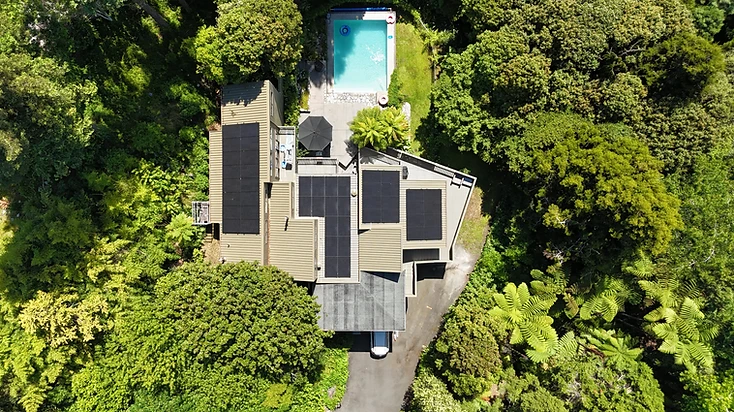
This Queenwood home sits amongst mature trees and has multiple roof levels and orientations.
2E Electrical installed an 18 kW system using north-facing, flat and south-facing roof areas.
From January to September 2026, the system generated approximately:
10.8 MWh
Total generation
3.08 MWh
From the 8 kW south-facing array
The south-facing panels don't produce as much as the better-oriented roof areas, particularly through winter. But the real monitoring data shows why we don't automatically rule out usable roof space.
What About a Battery?
Do You Need a Battery With Solar?
Not necessarily.
A battery can store surplus solar for use later, but whether one makes sense depends on when you use electricity, how much solar you export, electricity rates, battery size and what you want the system to achieve.
Some homeowners install solar first and add storage later.
Others want solar and a battery from day one.
We'll look at the numbers before recommending either approach.
Solar and EV Charging
Planning an EV? Tell Us Before We Design the Solar
An EV can become one of the larger electrical loads in a home.
If you already have an EV or think one may be coming, we can consider the solar system, switchboard, available supply and EV charger together.
Planning these together can avoid designing today's solar system without considering tomorrow's electricity use.
Our Installation Process
From Assessment to Installation
01
Free Solar Assessment
We start with your property, electricity use and what you want from solar.
02
System Design
We work out an appropriate system size, panel layout, inverter and battery options if required.
03
Clear Quote
You receive a clear proposal showing what we recommend and what's included.
04
Installation & Certification
Our electricians install, test and electrically certify the system.
05
Monitoring & Local Support
We help set up system monitoring and remain available locally after installation.
FAQ
Home Solar Questions
Something else on your mind? Ask us during your free solar assessment.
Free Solar Assessment
Find Out What Solar Could Look Like on Your Home
Send us a recent electricity bill and a few details about your property. We'll use that as a starting point to work out what size and type of system may suit your home.